

Once defined by dominance and swagger, USA Basketball now faces mounting scrutiny from fans questioning whether its identity has faded. This in-depth analysis explores how global competition, FIBA rules, roster construction, and shifting philosophies have reshaped Team USA. Is this a decline—or a necessary evolution? The answer reveals uncomfortable truths about modern international basketball.
Introduction: The Question That Once Felt Impossible
There was a time when American basketball fans never asked questions.
When USA Basketball stepped onto the international stage, the discussion wasn’t whether the team would win—it was by how much. Gold medals were assumed. Close games were anomalies. The jersey itself carried intimidation.
Fast forward to today, and the tone has changed.
Losses feel heavier. Wins feel harder. Roster decisions spark confusion rather than confidence. Social media debates no longer revolve around legacy but around relevance. Fans, analysts, and former players alike are asking a once-unthinkable question:
Is USA Basketball losing its identity?
This article doesn’t chase panic or nostalgia. Instead, it breaks down what that identity once meant, why fans feel disconnected now, what has objectively changed, and whether the current moment signals decline—or evolution.
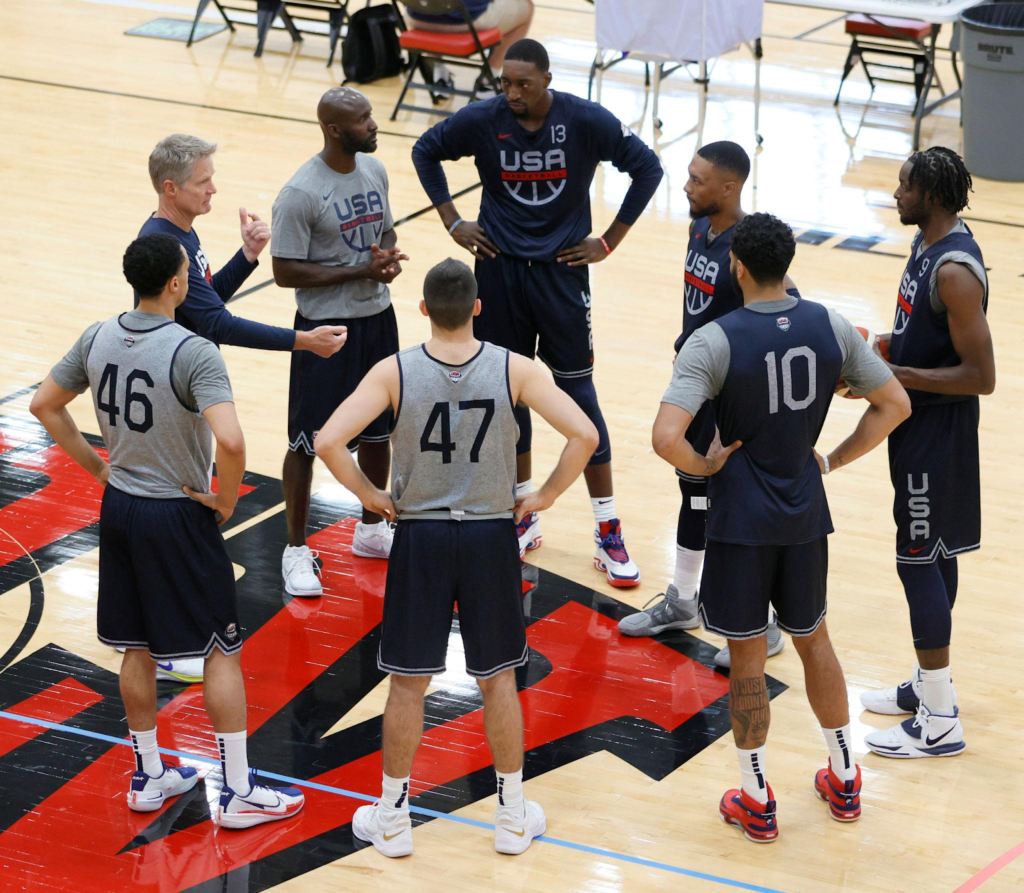
What “Identity” Meant for USA Basketball
To understand why fans feel something is missing, we must first define what existed.
Historically, USA Basketball’s identity rested on three pillars:
- Talent superiority
- Physical dominance
- Psychological intimidation
This identity reached its most iconic form with the 1992 Dream Team, a roster that didn’t just win—it redefined global basketball power.
Opponents didn’t compete; they survived. The message was unmistakable: American basketball played a different game.
That ethos continued through later eras, reinforced by stars like Kobe Bryant, LeBron James, and Kevin Durant. Even when games tightened, belief never wavered.
That belief is what fans fear is fading.
So What Actually Changed?
The simplest answer: the world caught up—and adapted faster.
Global Basketball Evolution
International programs no longer try to mimic the NBA. They design systems specifically to counter it.
Modern international teams emphasize:
- Continuous ball movement
- Collective defense
- Long-term chemistry
- Role clarity over individual stardom
Meanwhile, American players grow up in an ecosystem built around spacing, isolation scoring, and NBA officiating.
That difference matters deeply under international rules.
The FIBA Reality Fans Often Miss
International basketball isn’t NBA basketball with different logos.
Under FIBA Basketball World Cup rules, the game changes in ways that directly impact Team USA:
- Courts are smaller, shrinking driving lanes
- Defensive three-second rules are looser
- Physical contact is more tolerated
- Zone defenses are more effective
- Help defense arrives faster
These conditions neutralize some traditional American advantages while amplifying weaknesses—especially on defense and off-ball awareness.
Fans often see missed shots. Coaches see missed rotations.
Roster Construction: Talent vs. Translation
One of the loudest fan frustrations centers on roster selection.
“How does that player make the team while this star stays home?”
The anger is understandable—but the logic has changed.
USA Basketball now prioritizes translation, not reputation.
That means:
- Defensive versatility over scoring averages
- Role acceptance over highlight potential
- Availability and commitment over name value
This philosophical shift clashes directly with NBA-centric fan expectations.
Why Fans Feel Emotionally Disconnected
Identity isn’t just about strategy—it’s about emotion.
Many fans feel modern Team USA rosters lack:
- Clear leadership hierarchy
- Defined playing personality
- Emotional edge
Earlier teams felt cohesive and personal. Today’s rosters often feel temporary, assembled quickly and dissolved just as fast.
That lack of continuity weakens emotional investment—and fuels identity concerns.
Is Coaching the Problem?
Blaming coaches is easy—but incomplete.
Modern Team USA coaches emphasize:
- Defensive discipline
- Ball movement
- Role clarity
These priorities align with international success but don’t always look dominant or exciting. What fans interpret as passivity is often intentional restraint.
The issue isn’t coaching quality—it’s expectation mismatch.
Is the Player Pipeline the Issue?
American players are more skilled than ever—but differently skilled.
The AAU-to-NBA pipeline prioritizes:
- Individual creation
- Offensive freedom
- Statistical production
International play rewards:
- Defensive IQ
- Off-ball movement
- System discipline
Neither approach is wrong—but the transition is difficult.
Structural Challenges USA Basketball Faces
Unlike national teams that train together for years, Team USA must:
- Assemble rosters quickly
- Build chemistry rapidly
- Balance egos and roles
- Adapt to different rules immediately
This structural disadvantage makes dominance harder to sustain.
Real-World Examples That Fuel Fan Anxiety
Recent tournaments revealed recurring patterns:
- Struggles defending pick-and-roll
- Difficulty breaking zone defenses
- Late-game reliance on isolation
These moments don’t erase decades of success—but they create doubt.
Fans don’t fear losing games. They fear losing identity.
Redefining Identity in Modern Basketball
Here’s the uncomfortable truth: identity cannot remain static.
Modern Team USA identity may look like:
- Relentless team defense
- Shared offensive responsibility
- Depth over hierarchy
- Chemistry over celebrity
The question isn’t whether USA Basketball has an identity—it’s whether fans accept a new version of it.
Signs the Program Is Evolving, Not Collapsing
Despite criticism, positive indicators exist:
- Increased defensive emphasis
- Younger players embracing international play
- Greater continuity in leadership philosophy
Evolution often feels like loss before it feels like progress.
What USA Basketball Must Do Going Forward
To rebuild trust and clarity, the program should:
- Communicate its vision transparently
- Establish stylistic continuity
- Balance star power with system identity
- Encourage long-term national team commitment
Winning still matters—but so does connection.
Key Takeaways (Quick Read)
- USA Basketball’s identity was built on dominance and confidence
- Global basketball has closed the gap strategically
- Fan frustration reflects emotional disconnect, not collapse
- The program is evolving to survive modern competition
- A new identity is forming—intentionally or not

Frequently Asked Questions (FAQ)
1. Is USA Basketball really losing its identity?
Ans. No—it’s evolving. The identity is shifting to match modern international basketball.
2. Why does Team USA struggle more now?
Ans. Global competition has improved, and FIBA rules reduce traditional advantages.
3. Are NBA stars the problem?
Ans. No. Translation and fit matter more than raw talent.
4. Does USA Basketball still dominate internationally?
Ans. Yes, but the margin is smaller and requires greater discipline.
5. Why do fans feel disconnected from modern teams?
Ans. Short-term rosters and limited continuity reduce emotional attachment.
6. Is coaching to blame?
Ans. Coaching reflects international realities; it isn’t the core issue.
7. Did the Dream Team era distort expectations?
Ans. Yes. That level of dominance was historically unique.
8. Can USA Basketball regain its swagger?
Ans. Not the same way—but it can build a new, sustainable identity.
9. What matters more now: stars or chemistry?
Ans. Chemistry and defensive cohesion matter more in FIBA play.
10. What should fans expect moving forward?
Ans. Closer games, smarter basketball, and a redefined version of dominance.
Final Thoughts
The question “Is USA Basketball losing its identity?” reflects anxiety, not failure.
Basketball has changed. The world has adapted. And the program must adapt too.
Identity isn’t about overwhelming opponents forever—it’s about winning within reality. The sooner fans recognize that evolution, the sooner confidence returns.
USA Basketball hasn’t lost who it is.
It’s discovering who it needs to become.