
 By Andrew Sullivan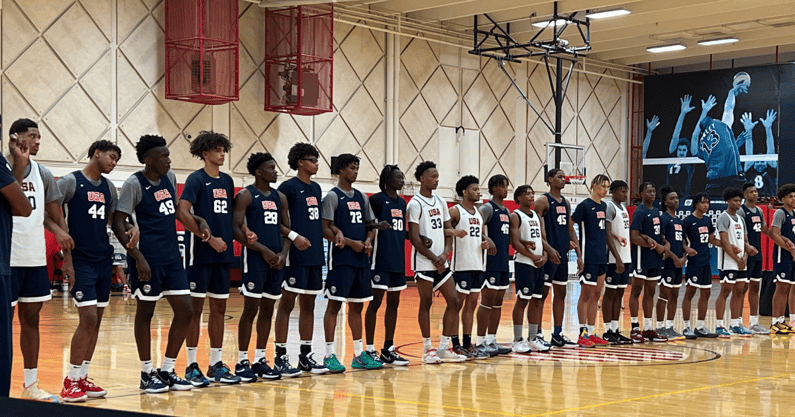
Insiders within USA Basketball believe the upcoming FIBA World Cup represents a defining moment for the program. Rather than relying solely on star power, Team USA is shifting toward continuity, defensive identity, and international adaptability. With global competition stronger than ever, preparation, chemistry, and role clarity may determine whether the U.S. regains unquestioned dominance.
A New Tone Inside USA Basketball Headquarters
Conversations surrounding USA Basketball feel notably different heading into the next FIBA World Cup. In previous cycles, the narrative revolved around assembling the most talent possible and trusting that dominance would follow. Today, insiders describe a quieter, more deliberate approach—one rooted in evaluation, humility, and long-term vision.
Executives and coaching staff are no longer asking, “Who are the biggest names available?”
Instead, the guiding question has become, “Who fits this tournament?”
This philosophical shift reflects a broader realization: international basketball has evolved. Talent gaps have narrowed, systems are stronger, and continuity often beats individual brilliance in short-format tournaments.
Lessons Learned From Recent International Setbacks
USA Basketball insiders openly acknowledge that recent international tournaments served as wake-up calls. Losses were not blamed on effort or desire but on structural mismatches between NBA habits and FIBA realities.
In multiple games over the past decade, Team USA entered fourth quarters with superior athleticism yet struggled to close. Defensive rotations broke down. Zone defenses stalled offenses. Rebounding gaps widened at the worst possible moments.
Real-world example
Several players admitted after past World Cup exits that they were still learning teammates’ tendencies deep into the knockout rounds. By contrast, opponents like Spain and Germany fielded rosters with years of shared experience.
The internal takeaway was clear: chemistry cannot be rushed.
Moving Away From Star-Driven Roster Construction
One of the most notable insider revelations is that celebrity is no longer the primary selection criterion.
This does not mean superstars are being excluded. Rather, they are evaluated through a different lens—one that prioritizes commitment, adaptability, and role acceptance.
Insiders say selection discussions now emphasize:
- Willingness to commit early in the cycle
- Comfort playing without constant offensive control
- Defensive versatility across multiple positions
- Experience or aptitude under FIBA rules
This mirrors international programs that value system loyalty over individual acclaim.
Why FIBA Rules Change Everything
Many NBA fans underestimate how dramatically FIBA rules alter the game. Inside USA Basketball, this reality is shaping every strategic decision.
Key differences include:
- No defensive three-second rule
- Goaltending allowed once the ball hits the rim
- More physical perimeter defense
- Shorter three-point line
These changes reward decisiveness, discipline, and toughness. Players who thrive in space-heavy NBA systems must adjust quickly—or risk becoming liabilities.
Insiders say roster construction now leans toward players who naturally excel in tighter spacing and physical environments.
Defense: The Quiet Obsession Behind the Scenes
Offense sells tickets. Defense wins international tournaments.
That mantra has quietly driven USA Basketball’s internal planning. Data reviews from recent competitions showed that Team USA often lagged behind gold-medal winners in defensive efficiency and rebounding margin.
As a result, defensive identity has become non-negotiable.
Key defensive priorities include:
- Reduced over-switching on the perimeter
- Better zone recognition and communication
- Collective rebounding responsibility
- Defensive versatility over single-skill specialists
Insiders believe that if Team USA defends consistently, its offensive ceiling will take care of itself.
Younger Players Are No Longer Viewed as Risks
Another meaningful shift involves age and experience.
Historically, international rosters leaned heavily toward veterans. Today, insiders see younger players as potential advantages rather than liabilities.
Younger athletes often:
- Adapt faster to coaching instruction
- Embrace defined roles more willingly
- Possess fewer entrenched NBA habits
- Play with greater urgency in limited-window tournaments
During recent development camps, younger invitees reportedly stood out for defensive intensity and off-ball movement—two traits essential for FIBA success.
Analytics Now Influence Decisions More Than Ever
USA Basketball has expanded its use of analytics beyond traditional NBA metrics.
Internal data models now consider:
- Performance against international competition
- Lineup chemistry across multiple camps
- Fatigue patterns in condensed schedules
- Defensive impact that doesn’t appear in box scores
This analytical approach doesn’t replace coaching instincts—it sharpens them.
For example, analytics helped identify certain lineups that rebounded exceptionally well together despite modest individual rebounding numbers. Those insights now influence role assignments and substitution patterns.
Chemistry Is No Longer Assumed—It’s Built
Perhaps the most candid admission from insiders is that chemistry can no longer be treated as automatic.
In previous eras, chemistry was expected to emerge naturally from talent concentration. Today, it is intentionally cultivated.
USA Basketball has emphasized:
- Longer minicamps
- Clearer communication of player roles
- Leadership identification early in the cycle
- Off-court bonding initiatives
Why does this matter? Because international games are often decided by a single possession. Hesitation, miscommunication, or ego clashes are luxuries teams can’t afford.
The Global Field Is Deeper Than Ever
Internally, there is no illusion about the competitive landscape.
Teams such as Serbia, France, Germany, and Spain are no longer viewed as underdogs. They are seen as equals with distinct strengths.
What sets them apart:
- Stable coaching staffs
- Consistent national pipelines
- Players who prioritize national duty
- Tactical flexibility
USA Basketball insiders emphasize that no game can be approached casually—not even in group play.
How USA Basketball Defines Success This Time
Winning remains the ultimate goal. But internally, success is being measured more holistically.
Key performance indicators include:
- Defensive rating across the tournament
- Ball movement consistency
- Late-game execution
- Lineup adaptability
- Evidence of sustainable program growth
The upcoming World Cup is viewed not just as a competition, but as a referendum on a new philosophy.
What Fans Should Watch Before the Tournament
For fans trying to predict Team USA’s World Cup fate, insiders suggest focusing on subtler indicators rather than final scores.
Watch for:
- Early roster commitment
- Defensive effort in exhibition games
- Willingness of stars to accept secondary roles
- Rebounding discipline
- Consistency in rotations
These factors often reveal more than highlight reels.
What This Means for the Future of Team USA
If successful, this approach could reshape Team USA for the next decade.
Rather than rebuilding after failures, the program aims to create continuity—where each tournament builds on the last.
Insiders believe the next World Cup will determine whether USA Basketball can evolve from a reactive powerhouse into a proactive global standard.
Final Thoughts: Evolution Over Ego
The most important insider takeaway is simple yet profound:
USA Basketball isn’t abandoning dominance—it’s redefining how dominance is achieved.
The next World Cup won’t just test talent. It will test preparation, humility, and adaptability in a global game that no longer bends to reputation alone.
Frequently Asked Questions (Trending)
1. Is Team USA still the favorite to win the next World Cup?
Ans. Yes, but insiders stress that the margin for error is smaller than ever due to improved global competition.
2. Why has USA Basketball changed its roster strategy?
Ans. Recent tournaments exposed issues with chemistry, defense, and FIBA adaptation, prompting a shift toward fit and continuity.
3. Will NBA superstars still play in the World Cup?
Ans. Yes, but commitment, role acceptance, and adaptability now matter as much as star status.
4. How important is defense under FIBA rules?
Ans. Extremely important. Physicality, zone defenses, and rebounding often decide games.
5. Are younger players more likely to make the roster now?
Ans. Yes. Younger players are viewed as more adaptable and open to defined roles.
6. How does analytics impact USA Basketball decisions?
Ans. Analytics guide lineup chemistry, workload management, and defensive efficiency analysis.
7. Which countries pose the biggest threat to Team USA?
Ans. Serbia, France, Germany, and Spain are widely regarded as top contenders.
8. Does winning the World Cup matter as much as the Olympics?
Ans. Internally, yes. The World Cup is seen as critical to long-term program credibility.
9. Will Team USA’s offense look different?
Ans. Expect less isolation and more ball movement against zones.
10. What should fans watch in pre-tournament games?
Ans. Defensive effort, rebounding, and lineup consistency matter more than final scores.