
 By Rachel Evans
The FIBA World Rankings play a powerful role in shaping global basketball, Olympic qualification, and international prestige. Yet behind the official formulas lies a system that quietly rewards consistency over competition quality and regional dominance over depth. This in-depth investigation explains how the rankings truly work, why elite teams feel undervalued, and what fans are rarely told about basketball’s global power structure.
Why FIBA World Rankings Matter More Than Fans Realize
To the casual fan, the FIBA World Rankings may look like a simple list of who’s best in international basketball. In reality, those rankings function as a gatekeeping mechanism that affects Olympic qualification routes, World Cup seeding, federation funding, sponsorship appeal, and long-term player development strategies.
At the center of it all is FIBA, the sport’s global governing body. While FIBA promotes its ranking system as transparent and data-driven, many coaches, analysts, and federation executives quietly admit that the system often fails to reflect the true competitive balance of international basketball.
Understanding why requires looking beyond the headline rankings and into the mechanics FIBA rarely explains in detail.
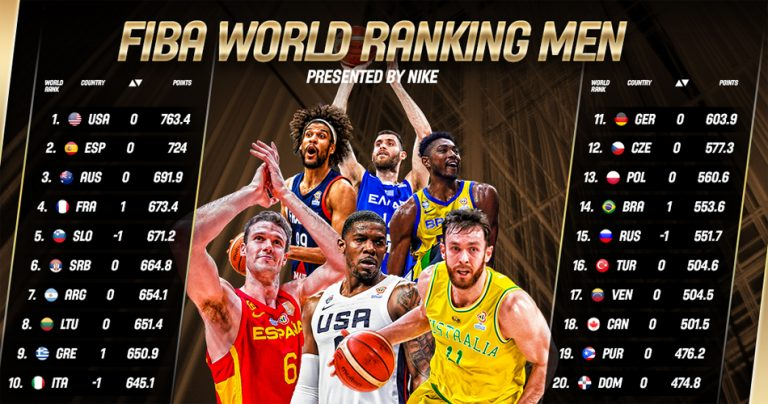
How the FIBA World Ranking System Actually Works
FIBA calculates rankings using results from officially sanctioned senior men’s and women’s national team games over an eight-year rolling cycle. The system replaced the old tournament-placement model in 2017, with the goal of rewarding consistency rather than one-off tournament success.
Core Factors in the Ranking Formula
The points awarded for each game depend on:
- Match result (win or loss)
- Strength of the opponent
- Type of competition
- Stage of the tournament
- Regional weighting
- Time decay (older games matter less)
On paper, this seems logical. In practice, it creates distortions that significantly impact how teams climb—or stagnate—in the rankings.
The Weighting System FIBA Rarely Explains Publicly
One of the least understood elements of the rankings is competition weighting. Not all wins are equal, and not all losses hurt the same.
For example:
- A World Cup win is worth significantly more than a continental championship win
- Olympic games carry the highest weight
- Qualification games often matter more than fans expect
- Friendly games barely move the needle
This leads to situations where a team can defeat elite opponents in high-profile tournaments yet see little ranking movement, while another team rises steadily by beating weaker competition in qualifiers.
Real-world consequence:
Several European teams have beaten top-10 opponents in major tournaments and still dropped in the rankings weeks later due to limited qualifier success.
Why Regional Imbalance Is the System’s Biggest Flaw
International basketball is not evenly distributed across regions. Europe, in particular, has a deep concentration of elite teams that routinely eliminate each other early in tournaments.
This creates a paradox:
- Europe produces more NBA-level talent than any region outside North America
- Yet European teams often struggle to maximize ranking points
- Early exits limit opportunities to earn high-value wins
Meanwhile, teams in less competitive regions can dominate qualifiers and accumulate points with greater consistency.
The system unintentionally rewards regional dominance over global competitiveness.
Olympic Qualification: Where Rankings Become Political
The rankings take on even greater importance when Olympic qualification is involved.
The Olympic Games allow only a limited number of basketball teams, making ranking position a critical determinant of:
- Direct qualification
- Placement in qualifying tournaments
- Seeding advantages
Since FIBA restructured its qualification windows, rankings have become a form of soft power—quietly shaping the field long before tip-off.
Federations rarely criticize the system publicly, but insiders acknowledge that rankings now influence competitive outcomes months or even years in advance.
Why NBA Talent Doesn’t Guarantee Ranking Supremacy
American fans often ask why a country with the NBA doesn’t dominate the rankings permanently.
The answer lies in participation patterns.
NBA stars frequently skip:
- Qualification windows
- Minor tournaments
- Continental championships
As a result:
- Losses with developmental rosters hurt rankings
- Wins provide limited upside
- Other nations benefit from continuity and chemistry
Ironically, having the world’s best league can weaken a national team’s ranking consistency.
Friendly Games: Great for Fans, Useless for Rankings
Exhibition games are valuable for experimentation, player evaluation, and fan engagement—but they carry minimal ranking weight.
That creates strange incentives:
- Teams avoid high-risk friendlies against elite opponents
- Coaches prioritize qualifiers over development games
- Fans miss out on marquee international matchups
A thrilling exhibition win against a top-five team may generate headlines, yet barely affect rankings.
The Problem With an Eight-Year Ranking Window
Basketball evolves rapidly. Players age, systems change, and national programs rise or fall within a few seasons.
Yet FIBA’s eight-year window means:
- Outdated success still influences current rankings
- Rebuilding teams remain artificially elevated
- Breakout programs struggle to catch up
Many analysts argue a shorter window would better reflect modern basketball realities—but reform remains slow.
How Federations Quietly Game the System
FIBA does not prohibit strategic scheduling, and federations have learned to optimize within the rules.
Behind the scenes:
- Games are scheduled for ranking efficiency
- Travel is minimized to protect win probability
- Player selection prioritizes consistency over star power
This isn’t cheating—it’s rational behavior under the incentives FIBA created.
Why Rankings Affect Money, Not Just Pride
In many countries, rankings influence:
- Government funding
- Sponsorship eligibility
- Media rights value
- Youth development budgets
A jump of even a few ranking spots can unlock millions in support. That financial reality discourages open criticism and explains why concerns remain largely behind closed doors.
Can FIBA Fix the Rankings?
Perfect fairness may be impossible, but meaningful improvements are realistic.
Experts frequently suggest:
- Adjusting regional weighting
- Increasing value of intercontinental games
- Shortening the historical window
- Rewarding strength of competition more aggressively
So far, FIBA has shown limited willingness to overhaul the system—but pressure continues to grow.
Key Takeaways for Fans and Analysts
- Rankings shape Olympic paths long before tournaments begin
- Regional depth can penalize elite teams
- Consistency often outweighs quality of competition
- NBA star power doesn’t guarantee ranking success
- Transparency remains the biggest missing piece
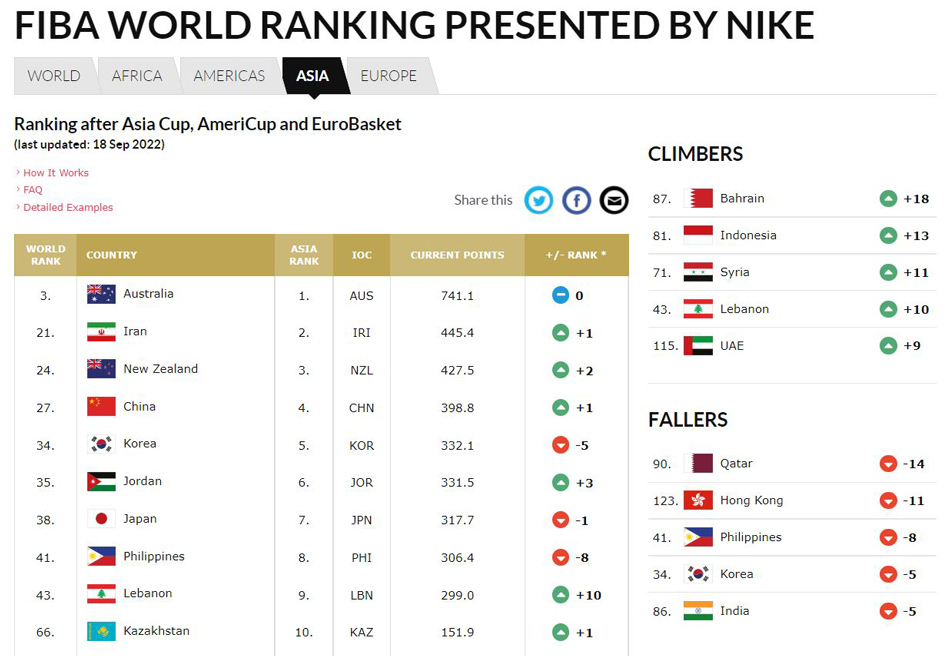
Frequently Asked Questions (Trending Searches)
1. What are FIBA World Rankings?
Ans. FIBA World Rankings measure national basketball team performance over an eight-year period using weighted results from official competitions.
2. How are FIBA rankings calculated?
Ans. Rankings consider wins and losses, opponent strength, competition type, tournament stage, regional weighting, and time decay.
3. Why isn’t Team USA always ranked number one?
Ans. Inconsistent participation in qualifiers and limited ranking value from exhibitions reduce ranking point accumulation.
4. Do friendly games count in FIBA rankings?
Ans. Yes, but their impact is minimal compared to qualifiers and major tournaments.
5. Why do European teams struggle in the rankings?
Ans. Europe’s depth causes elite teams to eliminate each other early, limiting opportunities for high-value wins.
6. How do rankings affect Olympic qualification?
Ans. Rankings influence direct qualification spots, seeding, and placement in Olympic qualifying tournaments.
7. Can teams manipulate the FIBA ranking system?
Ans. Not illegally, but federations strategically schedule games to maximize ranking value.
8. How often are FIBA rankings updated?
Ans. Rankings are typically updated after international windows, qualifiers, and major tournaments.
9. Has FIBA changed the ranking system before?
Ans. Yes, the current system was introduced in 2017 to emphasize consistency over tournament finishes.
10. Will FIBA reform the rankings again?
Ans. It’s possible, but no major structural reforms have been officially announced.
Final Verdict: What FIBA Really Doesn’t Emphasize
FIBA doesn’t necessarily hide how rankings work—but it rarely explains how deeply they shape the sport’s competitive and financial ecosystem. For fans, understanding the system transforms how international basketball is viewed. For federations, rankings are power. And power, in global sports, is never neutral.