
 By Brandon Lewis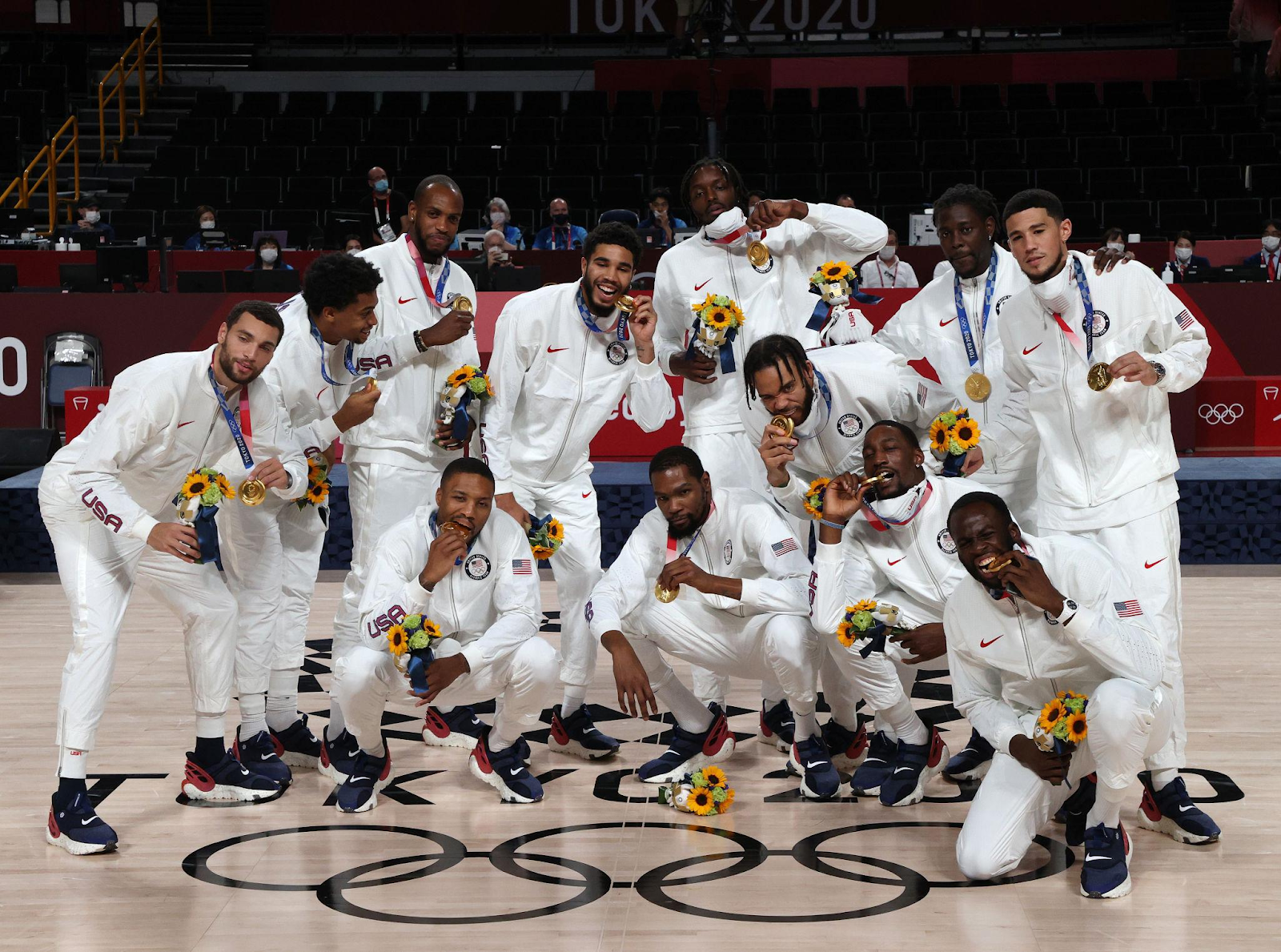
Despite claims that global basketball has caught up, the USA Men’s National Basketball Team continues to dominate international tournaments. The reason isn’t just star power—it’s a shocking statistical edge in net efficiency per possession, revealing how Team USA controls games beneath the surface, even when scores appear close. This hidden advantage explains why gold medals keep returning to the United States.
Why This Question Keeps Trending in the United States
Every Olympic cycle reignites the same national debate. Sports talk shows argue it. YouTube thumbnails shout it. Fans Google it relentlessly:
“If the world has caught up, why does Team USA still win?”
On the surface, the skepticism makes sense. International basketball has never been stronger. NBA rosters are filled with global stars. France, Serbia, Canada, and Spain regularly push the Americans to the brink. Some games even come down to the final minutes.
Yet when tournaments end, Team USA still walks away with gold more often than not.
This contradiction fuels curiosity—and controversy.
The answer doesn’t live in patriotism, nostalgia, or highlight reels. It lives in one statistic most casual fans never notice.
The Shocking Stat: Net Efficiency Per 100 Possessions
The single most revealing stat behind Team USA’s sustained dominance is net efficiency per 100 possessions.
In simple terms, this metric measures how many more points a team scores than it allows, adjusted for pace. It removes emotion, crowd noise, and narrative bias.
And when you examine this stat across Olympic Games, World Cups, and international tournaments, one truth becomes unavoidable:
Team USA is still in a different statistical universe.
Why Net Efficiency Matters More Than Final Scores
Final scores can be deceptive. Efficiency tells the truth.
A close five-point game can still feature:
- Massive shot-quality gaps
- Rebounding mismatches
- Turnover imbalances
- Late-game execution dominance
Team USA often wins the process of basketball even when the result feels uncomfortable.
That’s why analysts who rely on advanced metrics are rarely surprised by Team USA’s success—while casual viewers are.
The Numbers That Separate Team USA From the World
Across recent Olympic and FIBA tournaments, Team USA typically posts:
- +18 to +25 net efficiency per 100 possessions
By comparison:
- Elite challengers often range between +6 and +10
That gap is enormous.
It means that over the course of a full game, Team USA consistently creates:
- Better shots
- More stops
- Higher-value possessions
Even when the scoreboard says “tight,” the math says “controlled.”
Real-Life Example: The Illusion of the Close Game
Think about Olympic matchups that felt tense—France in 2021, Spain in earlier finals, Serbia in World Cup play.
Fans remember:
- Late-game drama
- Missed threes
- Nail-biting finishes
What the numbers reveal:
- Team USA generated more attempts at the rim
- Forced more turnovers
- Controlled defensive rebounds
- Outperformed in transition efficiency
Those hidden margins accumulate. By the fourth quarter, they decide outcomes.
Why International Teams Look Better Than Ever—but Still Fall Short
There’s no denying international progress. Many teams now play:
- Beautiful half-court basketball
- Highly disciplined defensive schemes
- Selfless offensive systems
But Team USA dominates in areas that rarely go viral.
The Hidden Areas Where Team USA Still Wins Games
Possession Control (Pointers)
- Forces turnovers at elite rates
- Converts steals into immediate points
- Limits opponents’ second-chance scoring
Shot Quality (Pointers)
- Generates more rim attempts
- Creates open threes through athletic collapse
- Avoids low-efficiency contested shots
Athletic Margin (Pointers)
- Faster defensive recovery
- Switchable defenders across positions
- Vertical spacing few teams can match
These advantages don’t always look flashy—but they show up relentlessly in efficiency stats.
The NBA Effect: Faster Processing Under Pressure
Most Team USA players operate within NBA systems built on:
- Pace
- Space
- Rapid decision-making
This creates a subtle but devastating edge.
When defenses break down for half a second, Team USA punishes instantly. International teams may recognize the opening—Team USA finishes it.
That difference defines possession efficiency.
Depth, Not Star Power, Is the True Weapon
Fans naturally focus on icons like LeBron James, Kevin Durant, and Stephen Curry.
But Team USA’s dominance isn’t just about who starts—it’s about who checks in next.
When rotations happen:
- Scoring doesn’t drop
- Defense doesn’t weaken
- Pace doesn’t slow
Efficiency remains elite across all lineups.
Few international teams can sustain that.
Why Team USA Owns the Fourth Quarter
If you isolate fourth-quarter metrics, Team USA’s advantage becomes even clearer.
Late games demand:
- Shot creation without set plays
- Defensive adaptability
- Free-throw reliability
Team USA thrives because:
- Multiple players can create offense
- Switch-heavy defense erases mismatches
- Pressure situations feel routine
That’s why “close games” often separate late.
Coaching, Analytics, and a Quiet Evolution
The myth that Team USA relies solely on talent is outdated.
Modern Team USA teams increasingly emphasize:
- Analytics-driven shot selection
- Matchup-specific rotations
- Defensive switching schemes
These adjustments directly improve efficiency and reduce variance.
Debunking the Myth: “Team USA Doesn’t Care”
One of the loudest criticisms is that Team USA lacks urgency.
The data disagrees.
Even during perceived lapses:
- Transition defense remains strong
- Turnover pressure stays consistent
- Rebounding margins hold
Baseline excellence prevents collapse.
How Team USA Compares to Its Biggest Challengers
Teams like:
- France men’s national basketball team
- Serbia men’s national basketball team
- Spain men’s national basketball team
…can match Team USA for stretches.
Over 40 minutes, efficiency gaps widen, fatigue compounds, and mistakes multiply.
Why Single-Elimination Doesn’t Break Team USA
Knockout formats increase chaos—but efficiency reduces randomness.
The best team doesn’t always win.
The most efficient team usually does.
That’s why Team USA survives moments when others collapse.
What This Means for Future Olympics
Games will continue to look closer. International stars will keep emerging.
But until another nation matches Team USA in possession efficiency, dominance will persist.
Talent can be matched.
Efficiency is far harder to replicate.
Key Takeaways for Fans
- Close games don’t equal declining dominance
- Efficiency reveals the real advantage
- Team USA controls possessions better than anyone
- Depth sustains performance across lineups
- Dominance has evolved—not vanished
Frequently Asked Questions (FAQ)
1. What is the shocking stat behind Team USA’s dominance?
Ans. Net efficiency per 100 possessions, where Team USA consistently outperforms all international teams.
2. Has international basketball caught up to Team USA?
Ans. In talent, yes—but not in efficiency and depth.
3. Why do Team USA games feel closer now?
Ans. Improved global execution masks underlying statistical gaps.
4. Does Team USA still dominate advanced metrics?
Ans. Yes. Efficiency ratings continue to favor Team USA heavily.
5. Why does Team USA close games better?
Ans. Superior shot creation, defense, and free-throw execution.
6. Is coaching still an advantage for Team USA?
Ans. Increasingly so, especially with analytics-driven strategies.
7. Do NBA players have an edge internationally?
Ans. Yes, due to pace, decision-making, and pressure experience.
8. Why doesn’t star power alone explain dominance?
Ans. Depth and lineup efficiency matter more than individual names.
9. Can another country match Team USA’s efficiency?
Ans. Not consistently—at least not yet.
10. Will Team USA always dominate international basketball?
Ans. Dominance may shrink, but efficiency suggests continued success.